Get Your Startup Registered in Just a Few Clicks
At I Way HR Consultancy Services, We understand that managing multiple registrations and compliance requirements can be complex and time-consuming. Our expert team helps businesses of all sizes register, renew, and stay compliant with government norms — efficiently and hassle-free.
Whether you’re starting a new business or maintaining statutory records for an existing one, we take care of it all — so you can focus on growth.
We manage documentation, application filing, and approvals for a wide range of business registrations and licenses. We Handle Comprehensive Range of Business Registrations
Business Registrations
- Private Limited Company Registration – Establish your business with limited liability and professional credibility.
- Limited Liability Partnership (LLP) Registration – Combine flexibility of a partnership with limited liability protection.
- Partnership Firm Registration – Register your partnership to formalize your business structure.
- One Person Company (OPC) Registration – Ideal for solo entrepreneurs to enjoy the benefits of a corporate structure.
- Proprietorship Registration – Get your sole proprietorship legally recognized.
EPF Registration
Businesses with more than 20 employees are required to register under the Employees’ Provident Fund & Miscellaneous Provisions Act, 1952.
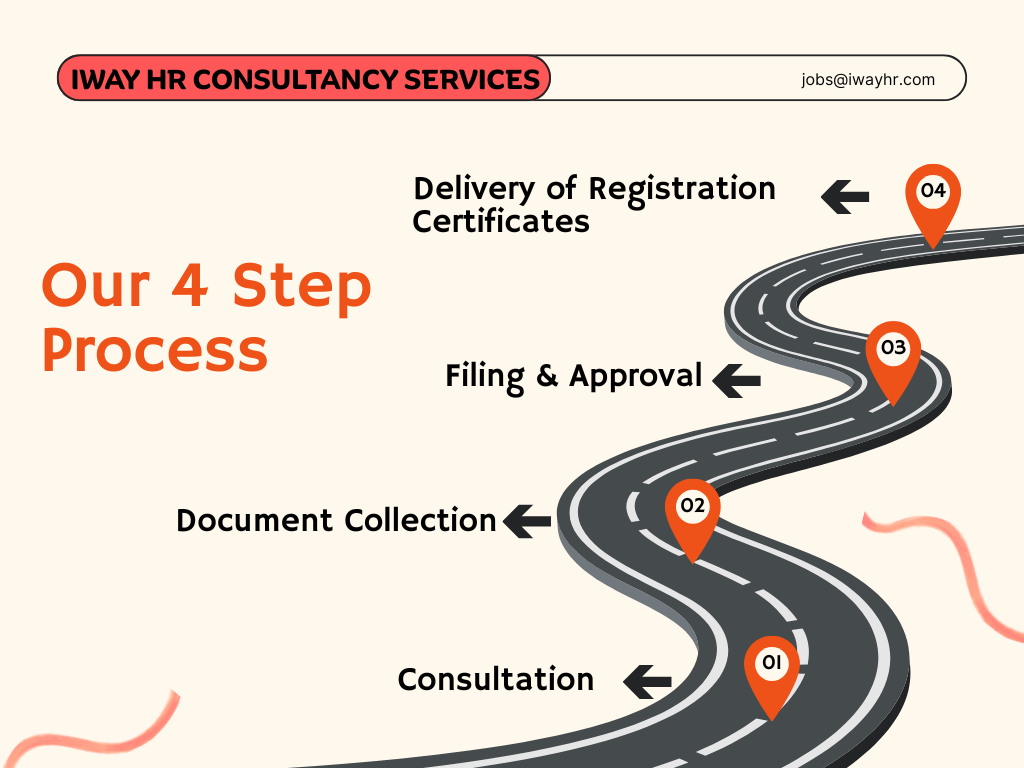
What we do to get your EPF registration
- Consultation – Understand your business structure and employee details.
Document Collection – Gather required forms, KYC, and company details.
Application Filing – Submit registration application to EPFO authorities.
EPF Account Setup – Receive Employer & Employee PF accounts with login details.
Ongoing Support – Assistance with contributions, compliance, and returns.
Professional Tax (PT) Registration
Professional Tax (PT) is a state-level tax in India that is levied on income earned by individuals through any profession, trade, or employment. It applies to salaried employees, self-employed professionals, and business owners, depending on the state’s rules.
Benefits of Paying Professional Tax :
- Avoids penalties and legal issues under the State’s PT Act.
- The amount paid as professional tax is allowed as a deduction under Section 16(iii) of the Income Tax Act.
- Payment receipts serve as official proof of your professional status or business activity.
- Necessary for obtaining trade licenses, government tenders, or business registrations in many states.
- Supports State Development.
FSSAI Registrations
ESIC Registration
ESIC registration is required for businesses that meet these criteria:
- Number of Employees : Any business employing 20 or more employees.
- Industry Coverage : Includes factories, shops, hotels, restaurants, cinemas, road transport, and other covered establishments.
- Types of Employees : Employees earning up to ₹21,000 per month.
- If your business has eligible employees under the ESIC scheme, registration is mandatory to provide them with health and social security benefits.
GST Registrations
The Goods and Services Tax (GST) is a mandatory indirect tax in India for businesses supplying goods or services.
GST registration is essential because it:
Legal Compliance: Avoids penalties, fines, or legal action from the government.
Input Tax Credit: Allows businesses to claim credit on taxes paid for purchases, reducing overall tax burden.
Business Credibility: Shows your customers and suppliers that your business is registered and compliant.
Market Expansion: Mandatory for selling goods or services inter-state or online.
Ease of Transactions: Makes invoicing and payments transparent and standardized.
Income Tax Registration (PAN & TAN)
Income Tax Registration involves obtaining a Permanent Account Number (PAN) and a Tax Deduction and Collection Account Number (TAN) from the Income Tax Department of India.
PAN is mandatory for:
Individuals, Freelancers, consultants, and professionals with taxable income.
Businesses, companies, LLPs, and firms operating in India, Trusts, NGOs, and other registered organizations.
TAN is mandatory for:
Any business or organization required to deduct or collect tax at source (TDS/TCS) — including employers, companies, contractors, and government departments.
MSME / Udyam Aadhaar Registration
The MSME (Micro, Small and Medium Enterprises) or Udyam Aadhaar Registration is a government recognition provided to small and medium businesses under the Ministry of Micro, Small and Medium Enterprises, Government of India.
Benefits of Udyam Aadhaar (MSME) Registration:
- Access to Government Schemes.
- Easy Bank Loans & Low-Interest Rates.
- Protection Against Delayed Payments.
- Preference in Government Tenders.
- Concession in Utility Bills & Taxes.
- Market and Export Support.
Shops & Establishment Registration
The Shops and Establishment Registration is a mandatory state-level license required for all commercial establishments such as shops, offices, restaurants, hotels, and service centers operating within a state.
Benefits of Shops and Establishment Registration:
- Gives your business a valid legal identity under state laws.
- Helps avoid penalties and ensures compliance with labor and employment regulations.
- Acts as a supporting document to open a current account for your business.
- Simplifies the process of obtaining GST, MSME, and other regulatory approvals.
- Ensures your business follows proper rules on wages, working hours, leave, and safety.
- Registered establishments can apply for state-level subsidies, incentives, and welfare schemes.
PASARA Registration
PSARA (Private Security Agencies Regulation Act) Registration is a mandatory license required for starting or operating a private security agency in India.
- Grants permission to legally run a private security agency and deploy trained guards across locations.
- Builds trust with clients as it shows your agency complies with all government norms and safety standards.
- Ensures all security personnel are verified, trained, and fit for service as per the Act’s requirements.
- Registered agencies can collaborate with government-approved training institutes for professional guard training.
- Allows the agency to operate and bid for private and government security contracts.
- Unregistered agencies face penalties or closure — PSARA registration safeguards your business legally.
KPME Registration
KPME (Karnataka Private Medical Establishment) Registration is a mandatory license under the Karnataka Private Medical Establishments Act, 2007, required for all private medical institutions operating in Karnataka.
- Allows medical establishments to operate legally under state healthcare regulations.
- Builds trust among patients, healthcare professionals, and government authorities.
- Registered institutions can participate in state and national health programs, insurance panels, and public welfare initiatives.
- Unregistered healthcare facilities can face fines, closure, or cancellation — KPME registration ensures compliance.
- Encourages continuous improvement in medical infrastructure, staffing, and safety standards.
- Acts as official proof of establishment for applying for bank loans, partnerships, or empanelment with insurance companies.
Contract Labour Outsourcing
Contract Labour Outsourcing means hiring workers through an external contractor or agency instead of employing them directly.
This system is governed by the Contract Labour (Regulation & Abolition) Act, 1970, ensuring proper rights and benefits for contract workers.
Benefits of Contract Labour Outsourcing :
- The contractor handles recruitment, salaries, attendance, statutory compliance (PF, ESI, LWF, PT, etc.).
- Saves on permanent staffing costs like PF contributions, gratuity, and training.
- You can easily scale up or down manpower depending on workload or seasonal demands.
- Lets the management focus on business growth while outsourcing non-core tasks.
- Contractors ensure all legal requirements are met, protecting the company from penalties.
Labour Welfare Fund(LWF) Registration
LWF stands for Labour Welfare Fund.
It is a statutory contribution managed by the respective State Labour Welfare Boards to promote the well-being of employees and their families.
The Labour Welfare Fund Registration is mandatory for certain establishments (like factories, shops, and commercial establishments) as per the state-specific Labour Welfare Fund Act.
Who Needs LWF Registration :
Employers with a minimum number of employees (varies by state, e.g., 5 or 10).
Both employers and employees contribute a small fixed amount to the fund.
Contribution frequency can be monthly, half-yearly, or yearly, depending on the state.
FSSAI Registrations
The Food Safety and Standards Authority of India (FSSAI) ensures that food products sold in India are safe, hygienic, and comply with food safety standards.
Types of FSSAI Registration:
- Basic FSSAI Registration – For small businesses (less than ₹12 lakhs turnover).
- State License – For medium-scale food businesses.(₹12 lakhs – ₹20 Crore/year)
- Central License – For large-scale or inter-state food businesses.(Above ₹20 crore or import/export)
Who Needs FSSAI Registration :
- Small food vendors, canteens, or tea stalls, Restaurants, bakeries, catering services.
- Food manufacturers or repackers, Storage and transport units dealing with food items
- Wholesalers, retailers, distributors, Online food sellers (Swiggy, Zomato, etc.)
Building and Other Construction Workers(BOCW) Registration
BOCW stands for Building and Other Construction Workers (Regulation of Employment and Conditions of Service) Act, 1996.
It applies to every establishment that employs 10 or more construction workers — such as builders, contractors, developers, and infrastructure companies.
Who Needs BOCW Registration :
Employers / Establishments engaged in construction, repair, or maintenance of:
Buildings
Roads, bridges, dams, canals, pipelines, etc.
Construction Workers — Individuals working at construction sites (masons, painters, electricians, plumbers, labourers, etc.)
Factory License
A Factory License is a mandatory registration certificate issued by the State Labour Department under the Factories Act, 1948.
It is required for any premises where:
Manufacturing activities are carried out using power, and
10 or more workers are employed (or 20 or more without power).
The license ensures that the factory complies with safety, health, and welfare standards prescribed under the Act.
Who Needs Factory License :
Any business involved in manufacturing or production using machinery or power — such as:
Engineering and fabrication units
Textile, chemical, or food processing plants
Printing, packaging, or assembly factories

- One-Stop Solution for All Business Registrations
- Experienced Compliance Professionals
- Transparent Process & Timely Updates
- End-to-End Documentation Support
- Affordable & Reliable Services